Over 70% of software teams now integrate at least one large language model API into their products — yet most developers admit they chose their provider based on name recognition, not performance benchmarks. That decision can cost you thousands of dollars a month and slow down your product roadmap.
This guide cuts through the noise. You will get a direct, technical comparison of the four most widely used LLM APIs for developers: OpenAI GPT-4o, Anthropic Claude, Google Gemini, and Meta Llama 3. By the end, you will know which API fits your use case, your budget, and your architecture — and you will have the data to back up that choice.
Whether you are building a RAG pipeline, a coding assistant, or a customer-support bot, the right API makes the difference between a prototype and a production system. Let’s get into it.
Understanding LLM APIs: What Developers Actually Need
More Than Just Intelligence
Raw benchmark scores rarely reflect real-world developer experience. What matters in production is a combination of latency, context window size, rate limits, pricing per token, and uptime SLAs. A model that scores 90% on MMLU but times out under load is useless for a live application.
The four providers in this comparison — OpenAI, Anthropic, Google, and Meta — each approach these trade-offs differently. Understanding those trade-offs is the first step to picking the right tool.
Key Metrics to Evaluate Any LLM API
- Context window: How many tokens the model can process per call — critical for document analysis and long conversations.
- Throughput and rate limits: How many requests per minute your tier allows. Most providers offer tiered limits based on spend.
- Pricing model: Input vs. output token pricing, batch discounts, and free tier availability.
- Tool/function calling: Native support for structured outputs and external tool integration.
- SDK quality: Official Python and JavaScript SDKs, streaming support, and async compatibility.
Why This Comparison Matters More in 2025
According to the Stanford AI Index 2024, the number of LLM API providers offering production-grade services tripled between 2022 and 2024. Developer lock-in is a real risk — switching providers mid-project means re-engineering prompts, adjusting rate-limit logic, and retraining your team. Getting the initial choice right saves weeks of rework.
1. OpenAI GPT-4o: The Default Choice and Its Limits
Why GPT-4o Dominates Mindshare
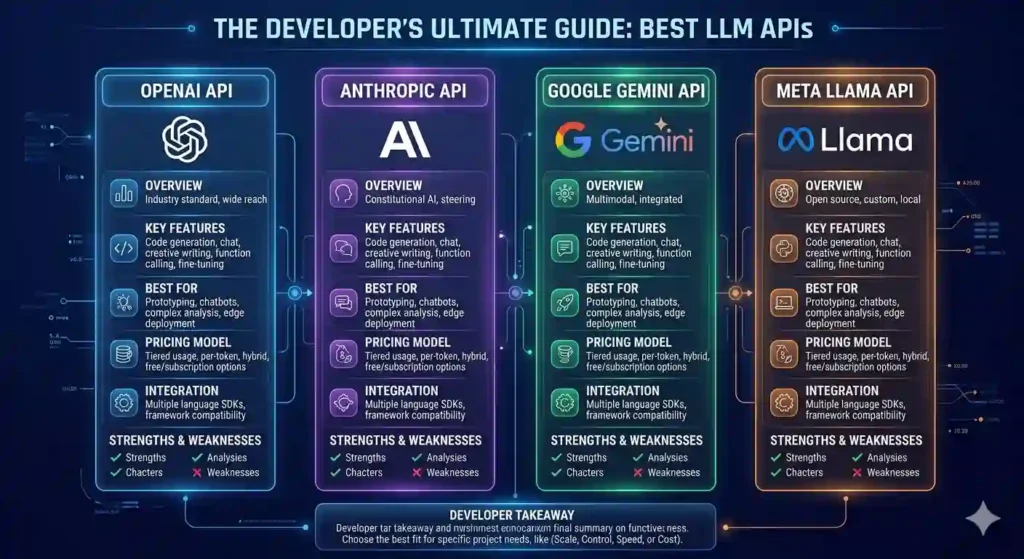
OpenAI’s GPT-4o remains the most widely adopted LLM API for developers, largely because it was first to market with reliable, well-documented tooling. Its Python SDK is mature, its function-calling interface is consistent, and its 128K token context window handles most real-world document tasks without chunking.
GPT-4o is genuinely multimodal — it processes text, images, and audio in a single model, which simplifies architectures that previously required separate vision models.
Pricing and Rate Limits
As of 2025, GPT-4o charges $2.50 per million input tokens and $10.00 per million output tokens at standard rates. The Batch API cuts those costs by 50% for non-real-time workloads, making it compelling for large-scale data pipelines. Free-tier users get rate-limited to 3 RPM, which is unworkable for anything beyond prototyping.
Where GPT-4o Falls Short
OpenAI’s pricing, while competitive at small scale, compounds quickly. A customer-support application processing 10 million output tokens per month hits $100,000 in API costs alone. Additionally, OpenAI’s terms of service restrict certain use cases around medical and legal advice, which surprises some developers building in those verticals.
There are also ongoing concerns in enterprise circles about data retention policies. OpenAI offers a zero-data-retention option, but it requires enterprise contracts with negotiated terms — not a simple API flag.
2. Anthropic Claude API: Built for Safety-Critical and Long-Context Applications
The 200K Context Window Advantage
Anthropic’s Claude API leads the field on context window size, supporting up to 200,000 tokens as a standard offering. For developers building legal document review tools, codebases analysis pipelines, or research assistants, this eliminates the chunking and retrieval complexity that plagues smaller-context models.
Claude 3.5 Sonnet, released in 2024, scored above GPT-4 on several coding and reasoning benchmarks while remaining faster and cheaper per token — a combination that surprised many developers who had written off Anthropic as the ‘safe but slow’ option.
Constitutional AI and Why It Matters for Products
Anthropic trains Claude using a method called Constitutional AI, which aligns the model’s outputs to a defined set of principles rather than relying purely on human feedback. In practice, this means Claude is significantly less likely to produce harmful or off-topic outputs without explicit jailbreaking — valuable for B2C products where you cannot control user inputs.
If you are building a product that touches sensitive data, regulated industries, or vulnerable users, Claude’s refusal behavior is more predictable and auditable than its competitors.
Integration with Python Workflows
Anthropic’s Python SDK follows familiar conventions and works smoothly with async frameworks like FastAPI and Celery. If your team already works in Python and uses MongoDB as a backend, the Claude API slots in cleanly. You can store conversation history and retrieved context directly in MongoDB, pass it to Claude, and stream responses back to your users.
For teams building AI-powered applications on top of document stores, check out how vector databases accelerate AI apps — a natural complement to any LLM API integration.
3. Google Gemini API: The Longest Context Window and Ecosystem Play
One Million Token Context: Real Use Cases
Google’s Gemini 1.5 Pro offers a 1 million token context window — roughly 700,000 words, or the entirety of a large codebase. This is not just a benchmark trophy. Developers working on repository-level code understanding, full-book analysis, or hour-long video transcription now have a model that can process the entire input in one shot.
According to Google’s technical report, Gemini 1.5 Pro maintained near-perfect recall across its full 1M token window in synthetic tests — a claim that, if it holds in production, redefines what ‘long context’ means.
Pricing Edge for High-Volume Workloads
Gemini 1.5 Flash, the lighter variant, prices at $0.075 per million input tokens — an order of magnitude cheaper than GPT-4o. For classification, summarization, or extraction tasks that do not demand frontier-level reasoning, Gemini Flash is one of the most cost-effective options available.
Gemini 1.5 Pro sits at $1.25 per million input tokens for prompts under 128K tokens, rising to $2.50 for longer contexts. Still competitive with OpenAI’s flagship at a fraction of the output cost.
Google Ecosystem Lock-In
The Gemini API’s tightest advantage is its integration with Google Cloud — Vertex AI, BigQuery, and Google Workspace. If your infrastructure already runs on GCP, using Gemini means unified billing, native IAM, and direct data access without copying data across clouds.
The trade-off is that Gemini’s SDK and documentation lag behind OpenAI’s in maturity. Error messages are less descriptive, streaming behavior has had documented inconsistencies, and the function-calling interface changed significantly between API versions in 2024 — a headache for teams that had already built integrations.
4. Meta Llama 3: Open Source Power and Self-Hosting Reality
Why Open Source Changes the Economics
Meta’s Llama 3, released in April 2024, is the most capable openly licensed LLM family available. The 70B parameter model matches or exceeds GPT-3.5 Turbo on most benchmarks, and the 405B variant competes with GPT-4 class models on coding and reasoning tasks — at zero per-token cost if you self-host.
For startups processing high volumes of text with predictable patterns — think e-commerce product tagging, content moderation, or internal search — self-hosting Llama 3 on a reserved GPU instance can cut inference costs by 80% or more compared to frontier API providers.
What Self-Hosting Actually Requires
The word ‘free’ comes with a caveat: operational complexity. Running Llama 3 70B at production latency requires at minimum two A100 80GB GPUs, which rent for around $6–8 per hour on major cloud providers. That works out to roughly $4,400–$5,800 per month for a single inference node — before engineering time, monitoring, and autoscaling overhead.
Self-hosting is cost-effective when your token volume is high and predictable. It is usually not worth it for early-stage products with uncertain demand.
Managed Llama via API Providers
The practical middle ground is using Llama 3 through managed inference providers like Together AI, Fireworks AI, or Amazon Bedrock. These services offer Llama 3 at rates between $0.20 and $0.90 per million tokens — significantly cheaper than OpenAI or Anthropic — without the operational burden of self-hosting.
For Python developers exploring Llama 3 in an AI coding workflow, the guide to AI coding assistants for Python developers covers how open-source models fit into real development environments.
Choosing the Right LLM API for Your Use Case
For Production Web Applications
If you need a reliable, well-documented API with broad community support, OpenAI GPT-4o is the lowest-friction choice. Its SDK is battle-tested, its function-calling API is stable, and the ecosystem of third-party tools — LangChain, LlamaIndex, Instructor — has the deepest OpenAI integration.
The MongoEngine documentation and community tutorials predominantly feature OpenAI examples for this reason. If you are new to LLM integration and want to ship fast, start here.
For Regulated Industries and Enterprise
Choose Anthropic Claude when your product touches sensitive user data, healthcare, legal, or financial information. Claude’s Constitutional AI training produces more consistent refusal behavior, its 200K context window handles large documents natively, and Anthropic’s enterprise agreements include data privacy terms that satisfy most compliance teams.
According to Anthropic’s usage policy documentation, Claude is explicitly designed for deployment in high-stakes settings, with documented guidelines for responsible use in sensitive domains.
For Cost-Sensitive, High-Volume Workloads
For workloads where you process millions of tokens daily on well-defined tasks — extraction, classification, summarization — Gemini 1.5 Flash or Llama 3 via managed inference will deliver the best cost-per-task ratio. Run a token budget analysis before committing: at 100 million tokens per month, the difference between GPT-4o and Gemini Flash is roughly $2,400 vs. $7.50 — a number that is hard to argue with.
Frequently Asked Questions
Which LLM API is cheapest for developers?
Google Gemini 1.5 Flash is currently the cheapest among major commercial providers, at $0.075 per million input tokens. For even lower costs, running Meta Llama 3 through managed inference providers like Together AI can bring costs below $0.25 per million tokens, without the overhead of self-hosting.
Is the OpenAI API still the best for general use?
For most general-purpose use cases, yes — OpenAI GPT-4o offers the best combination of performance, SDK maturity, and ecosystem support. However, Anthropic Claude 3.5 Sonnet has closed the gap significantly on coding and reasoning tasks, and may outperform GPT-4o on long-document workloads thanks to its 200K context window.
Can I use Llama 3 without self-hosting?
Yes. Managed inference providers including Amazon Bedrock, Together AI, Fireworks AI, and Groq all offer Llama 3 via API at competitive per-token rates. This gives you the cost benefits of an open-source model without managing GPU infrastructure yourself.
How does context window size affect my application?
A larger context window means you can pass more content to the model in a single request — entire documents, long conversation histories, or large code files — without splitting and re-assembling results. For RAG pipelines, a larger context window can reduce retrieval complexity. For chatbots, it extends how much conversation history the model retains.
Which LLM API is best for Python developers?
All four providers offer official Python SDKs. OpenAI’s SDK is the most mature and widely documented. Anthropic’s SDK is clean and async-friendly. Google’s Gemini SDK integrates well with Google Cloud services. For Python developers building data-heavy applications, consider how your LLM API interacts with your database layer — MongoEngine users will find that any of the four APIs pairs well with a MongoDB backend for storing context and conversation state.
Final Verdict: Picking Your LLM API
No single LLM API wins across every dimension — and that is actually good news. It means you can optimize your choice for what matters most to your product.
Here are the three most important takeaways from this comparison:
OpenAI GPT-4o is the safest default for general-purpose applications — mature SDK, large community, and reliable uptime.
Anthropic Claude is the right call for regulated industries or any application where predictable, safe outputs are non-negotiable — and its 200K context window is a genuine differentiator.
For cost-sensitive workloads, Gemini Flash and managed Llama 3 inference can reduce your API bill by 80–95% compared to frontier models, with acceptable quality trade-offs on structured tasks.
The best approach for most teams is to start with one provider, benchmark it against your actual workload, and switch or split traffic once you have real performance data. Avoid architectural lock-in by abstracting your LLM calls behind a thin client layer from day one.
If you are integrating an LLM API with a Python-based backend, explore the MongoEngine ecosystem — the MongoEngine homepage has resources on building production-grade AI applications with document-oriented data models that pair naturally with any of the APIs covered here.

Matt Ortiz is a software engineer and technical writer with 11 years of experience building data-intensive applications with Python and MongoDB. He spent six years at Rackspace engineering cloud-hosted database infrastructure, followed by three years at a New York-based fintech startup where he led backend architecture for a real-time transaction processing system built on MongoDB Atlas. Since joining the MongoEngine editorial team in 2025, Matt has expanded his focus to the broader AI developer stack — reviewing coding assistants, vector databases, LLM APIs, RAG frameworks, and image generation tools across hundreds of real-world test scenarios. His writing is read by engineers at companies ranging from early-stage startups to Fortune 500 technology teams. When a tool earns his recommendation, it’s because he’s used it in production.
Follow on Twitter: @mattortiz40